My previous post’s main claim was the following: “technology aspires to permanence but is the product of a short-term conception of time” (yes, I am quoting myself, why not). I ended on a personal note, saying that it would be nice to see a change: consider technology’s long-term evolution in the decisional and design process.
Do not get me wrong, there isn’t any magical fake large language processing prediction bullshit wand involved here. Rather, I suggest starting by (1) making discourses of time salient and (2) researching new long-term design approaches e.g. thanatosentivitity, rituals of letting go.
Surely changing how we think about time is great, but do we have the tools required to evaluate how user experience develops over time? Surprisingly, this research question only emerged in the 2010s with one paper standing out: UX Curve: A method for evaluating long-term user experience. It is essentially a survey tool “for supporting users in recalling important details of the product qualities that affect user experience”. Participants are asked to draw how their experience evolved through time and provide reasons why it did.
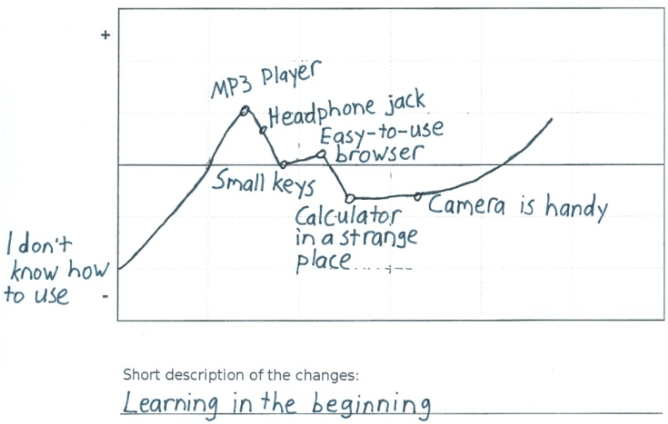
for changes
Your faithful servitor asked Sari Kujala to go back on the paper method and implications. She is a friendly researcher from Aalto University, Finland. We talked about her ski session in the afternoon, long-term user experience, and her view on what is meaningful UX.
margelacool: The UX curve paper was published twelve years ago, is it still an important paper for you now?
Sari Kujala: Yes, it is. Today I am focused on eHealth user experience. If you want to support people in changing their way of living, it doesn’t help if they are only doing it for a week, you need to think long-term.
margelacool: If we go back in time to understand why you and other researchers, like Karapanos and colleagues, looked into long-term user experience evaluation, we can clearly see a significant gap in the literature compared to the initial acceptance/adoption of a product. The two main reasons to explain this lack of interest in long-term user experience were (1) the cost of doing longitudinal studies, and (2) the perceived weak commercial value of prolonged user experience. How to overcome these two obstacles?
Sari Kujala: It wasn’t difficult to convince companies we worked with at the time, that there was commercial value in long-term user experience. Indeed, if your goal as a company is to last, you should care about your customer loyalty, and how your customers talk about your product, even months after adoption. However, longitudinal studies always require a lot of resources. To overcome this, there are a few methods. Essentially, we collect subjective memories and single-peak experiences. So we ask participants to recall critical experiences, whether they are negative or positive. We are looking for strong emotional memories. Needless to say this type of retrospection is highly subjective, and people have criticized these methods. But I believe user experience is subjective. Hence, these methods are still relevant.
margelacool: One of the paper’s conclusions is the following “we should study prolonged experiences and understand how a product becomes meaningful in a person’s life.” Could you expand more on what you wanted to convey here?
Sari Kujala: Of course, a meaningful UX is about emotional reward and attachment. But it is also about how it supports your identity and your well-being. I am referring to the self-determination theory here.
margelacool: Could long-term user experience evaluation methods be part of a larger movement, a rethinking of UX research?
Sari Kujala: Yes. Before UX followed Hassenzahl’s pragmatic (e.g. usability and usefulness) vs hedonic qualities (e.g. enjoyability, emotional attachment, attractiveness) dichotomy. In that framework, enjoyability played an essential role. To make it simple, it was all about maximizing fun and stimulation. But now, I see new concepts emerging about “eudaimonic” (the notion of striving towards one’s personal best), and meaningful experiences. Elisa D. Mekler for example looks into eudaimonia UX empirical grounds, pretty interesting stuff.
margelacool: Exciting, but I feel like these approaches are always quite individualistic, whereas our experiences of technology in general, especially in the long term are happening at a societal scale. Is there any long-term UX societal framework out there?
Sari Kujala: Traditionally UX has been all about the individual. It’s true that we need to acknowledge its collective and societal dimensions. What would be a long-term societal approach to UX is a great question that remains unanswered.
What would be a long-term societal approach to UX is a great question that remains unanswered
Thank you Sari for this inspiring conversation. As always feel free to share your thoughts if you have any @margelacool

Credit to Emilie Lor/@_kknomos for the speedy snail (go check her work now)
 margelacool
Leave a comment