
Have you ever woken up with a strong desire to dance into a pot of cherry marmalade and report illegal online content? Unfortunately I have yet to make cherry marmalade as Germany’s cherry season starts in early June.
Anyway, let me walk you through how to report illegal content online. But dear reader, don’t be fooled, this humble blog post’s intention is not to provide an exhaustive critical literature. Na. I’d rather lay out all the bare naked thoughts that sprouted in my head while testing each reporting journey.
Warning: If you are not familiar with European regulations, this post mentions quite a bit the Digital Services Act (DSA), the first European law that designates platforms ranging from Instagram to Pornhub as high risks architectures bound by obligations.
Sooooo if you are in Europe, you can report illegal online content to:
- the platform where the content was posted (mandatory since the Digital Services Act came into force)
- national authorities websites
- NGOs running reporting hotlines
ON A PLATFORM
Marie-Therese Sekwenz and Simon Parkin know their way through this pathway. In fact with Ben Wagner they co-wrote and published an academic paper all about it titled “It is unfair, and it would be unwise to expect the user to know the law!” – Evaluating reporting mechanisms under the Digital Services Act.
The paper’s core idea is pretty straightforward: documenting ALL the steps to report illegal content on TikTok and Facebook for France, Germany, Austria, AND showing the results to 12 professionals involved in the Digital Services Act universe. In more simplistic terms, showing people who drafted a regulation how one rule looks NOW on people’s screens, and asking what do they think.
The result is a legal design “knowledge artifact”, a snapshot of what one online /right (users) /obligation (platforms) looks like at a given moment in time. In addition, having this shared understanding can be “eye-opening” for online rights professionals who barely use those reporting features. In my work, I am often reminded that most people in this space are not influencers and barely know the intricacies of the platforms interface they seek to regulate. Even though I also don’t count myself as a hardcore user anymore (2015 me was), once in a while I LOVE to dig around and lose my self in a platform help center maze.
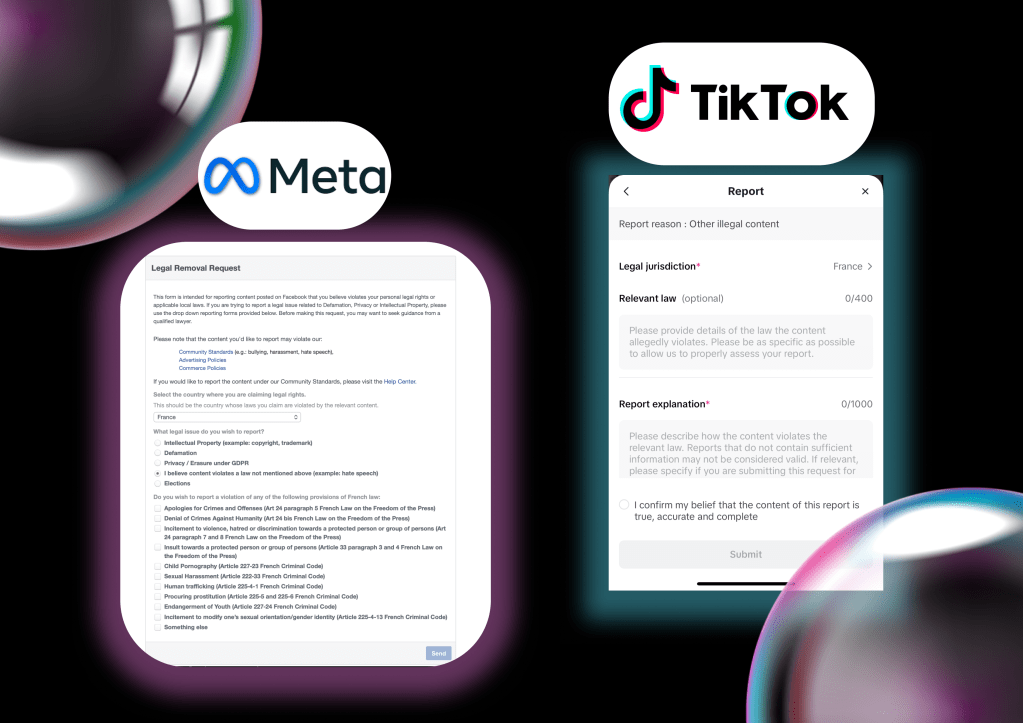
Concerning the actual steps, each platform has its own special spice to design reporting forms. On Facebook and Instagram after clicking everything on your screen, you have to select a section of the law only for a set of European countries, whereas TikTok has one approach for all European countries (see image bellow). In addition to clicking frenetically like a Switfie on Ticketmaster, on Facebook or Instagram you might be discouraged by sentences such as “you may want to seek guidance from a qualified lawyer.”
ELSEWHERE
Browsing through reporting forms designed by platforms, I wondered where people went before platforms were required to offer dedicated reporting channels?
What I found is a fragmented answer.
The best way to grasp this fragmentation is to browse the list of resources compiled by Europol:
https://www.europol.europa.eu/report-a-crime/report-illegal-content-on-the-internet
What looks at first glance like a single reporting hub is actually a patchwork of very different systems: specialist police portals dedicated to illegal online content (such as in France or Finland), general crime reporting websites (such as Spain’s), and NGO-run child protection hotlines (such as Estonia’s).
The result is confusing. The categories, responsibilities, and reporting pathways are inconsistent from one country to another. In some cases, people are directed toward law enforcement; in others, toward NGOs; elsewhere, toward generic administrative portals that are not specifically designed for online harms.
What about hotlines for other illegal online content that’s not about child sexual abuse? Why are they not in this Europol list? Why Finland and France are the only police websites for illegal online content? How many people are confused and stop at this Europol page?
Don’t get me wrong, I strongly believe that having multiple diverse remedies could make online accountability more resilient. And we live in a time where remedies actually exist (yey)! However, because of confusing decision hubs websites such a Europol’s, this leads to fragmentation, confusion, and potentially powerlessness. I see a huge parallel between the European Commission website listing all the DSA out-of-court-dispute settlement bodies and Europol’s list. Both are confusing and don’t provide any guidance.
Anyway, see you in Cherry Season
Thank you Marie-Therese Sekwenz and Simon Parkin for taking the time to chat with me and for the thought-provoking conversation. Deeply appreciate it!!!
“It is unfair, and it would be unwise to expect the user to know the law!” – Evaluating reporting mechanisms under the Digital Services Act → https://dl.acm.org/doi/10.1145/3715275.3732036
Marie-Therese Sekwenz’s work → https://www.tudelft.nl/en/staff/m.t.sekwenz/
Simon Parkin’s work → https://research.tudelft.nl/en/persons/se-parkin/
thank you Midas Nouwens for sending me the paper in the first place and always sending me cool stuff

Credit to the goat, Emilie Lor/@kknomos for the slutty sea slug inspired from jojo
do you like stoner rock metal/alternative rock + linear algebra + fantasy books? check my bro’s website


Leave a Reply